
A lot of people don't avoid yoga because they hate yoga.
They avoid it because they think yoga has already rejected them.
Maybe you've told yourself you're too stiff. Too busy. Too old. Too out of shape. Maybe you've looked at photos of people twisting themselves into pretzel-like poses and thought, "That's not for me."
If so, you're not alone.
A while back, I wrote about beginning yoga in your 50s and why it is never too late to start.
The response to that article was wonderful, but it also revealed something interesting.
Most people are not worried about their age.
They are worried they are not flexible enough.
Not calm enough.
Not fit enough.
Not coordinated enough.
Not "yoga enough."
Somewhere along the way, many people picked up the idea that yoga is something you earn. That before you can roll out a mat, you need to become a certain kind of person.
You need to be bendy.
You need to be peaceful.
You need to know what all the poses are called.
You need matching leggings and a water bottle that costs more than your first car.
Of course, none of that is true.
Yet these stories keep people from experiencing something that could genuinely make their lives better.
If you've ever thought yoga wasn't for you, this article is for you.
The Biggest Lie People Tell Themselves About Yoga
The most common thing I hear is:
"I'll start yoga when I'm more flexible."
Think about that for a minute.
It's a little like saying:
"I'll start taking piano lessons when I can already play songs."
Or:
"I'll start gardening after I grow some flowers."
Flexibility is not a requirement for yoga.
Flexibility is one possible result of yoga.
Nobody expects to walk into their first yoga class and immediately touch their toes. Nobody should.
Some people can. Some people can't.
Neither one matters.
The point is not where you start.
The point is that you start.
According to Yoga Alliance, more than 38 million Americans practice yoga, making it one of the most popular wellness activities in the country. Yet many people still avoid it because they believe they aren't flexible enough to begin. Yoga Alliance Research Report
The irony is that many experienced yoga practitioners would tell you they started for exactly the same reason.
They were stiff.
Their backs hurt.
Their hips hurt.
Their shoulders hurt.
They wanted to move better.
Yoga met them where they were.
"I'm Not Calm Enough for Yoga"
This one makes me smile.
People often tell me they can't do yoga because their minds won't stop racing.
As though yoga is only for people who already have inner peace figured out.
If that were true, yoga studios would be empty.
Most people come to yoga because they are stressed.

Kaleidoscope
Because life is busy.
Because they're caring for aging parents.
Because they're raising children.
Because they're worried about finances.
Because they're trying to navigate retirement.
Because they're carrying responsibilities that feel heavy.
A busy mind is not evidence that yoga isn't for you.
It's often the reason you need it.
You do not have to arrive calm.
You simply have to arrive.
Some days yoga looks like flowing through poses.
Other days it looks like lying on your back and taking five slow breaths.
Both count.
"I Don't Look Like a Yoga Person"
Let's talk about the image problem.
If your only exposure to yoga comes from social media, it would be easy to believe yoga belongs to young, athletic people wearing expensive clothes while balancing on one hand on a beach somewhere.
That version of yoga exists.
It is also a very small part of yoga.
The yoga I see is much more interesting.
It is women in their 50s, 60s, and 70s deciding they want to take better care of themselves.

A Flower Blossoms for Its Own Joy
It is people recovering from injuries.
It is people managing arthritis.
It is people who have spent decades putting everyone else first and are finally making a little room for themselves.
It is people who wobble.
People who modify.
People who laugh when they fall out of a pose.
People who show up exactly as they are.
Research has found that yoga can support balance, mobility, flexibility, and overall well-being as we age, even for people who begin later in life. National Institutes of Health Review on Yoga and Healthy Aging
You do not need a certain body.
You do not need a certain age.
You do not need permission from anyone.
What Yoga Actually Looks Like in Real Life
One of my favorite things about hosting retreats and yoga experiences at Big Raven Farm is watching people settle into themselves.
The first day often starts with uncertainty.
Someone worries they won't be able to keep up.
Someone else apologizes for being stiff.
Another person mentions they haven't practiced in years.
Then something happens.
People realize nobody is keeping score.
Nobody cares how deep someone folds.
Nobody is handing out trophies.
Nobody is measuring success based on flexibility.
By the second day, people are laughing more.
Moving more freely.
Trusting themselves more.
The pressure disappears.
The experience becomes less about performing yoga and more about experiencing it.
That's what yoga looks like in real life.
Not perfection.
Presence.
What If You Haven't Practiced in Years?
There is another group of people I hear from all the time.
They aren't beginners.
At least, not exactly.
They practiced yoga years ago. Maybe in their 30s. Maybe after a friend invited them to a class. Maybe during a season when they had a little more time for themselves.
Then life happened.
Jobs changed.
Children arrived.
Parents needed care.
Schedules filled up.
One missed class turned into a month. A month turned into a year. Before they knew it, yoga became something they used to do.
If that sounds familiar, I want you to know something.
You are not starting over.
You are simply returning.
The body may feel different than it did ten or twenty years ago. You may move more slowly. You may need more support. You may discover poses that once felt easy now require patience.
That's normal.
The good news is that yoga is remarkably patient.
Capricorn
It doesn't care whether you've practiced every day for the last decade or whether your mat has been rolled up in a closet since 2018.
The practice is still there waiting for you.
One of the most beautiful things about yoga is that it welcomes returns.
You don't have to earn your way back.
You simply unroll the mat and begin again.
And honestly, some of the most meaningful practices happen after a long break because you stop trying to prove something and start paying attention to what your body actually needs.
Why Your Environment Matters More Than Discipline
A while back, I wrote a blog called How to Stay Consistent with Yoga: Your Environment Matters More Than Discipline.
I still believe that might be one of the most important lessons I've learned.
Most people assume consistency comes from willpower.
They imagine disciplined people wake up every morning excited to exercise, meditate, stretch, journal, and drink green smoothies.
In reality, most habits are shaped by what surrounds us.
Think about where your yoga mat lives right now.
Is it rolled up on a shelf in a closet?
Stored in a basement?
Tucked behind a piece of furniture?
If it takes ten minutes to find it, move furniture, clear a space, and set everything up, your practice has to overcome a lot of friction before it even begins.
Now imagine something different.
A small corner of your home.
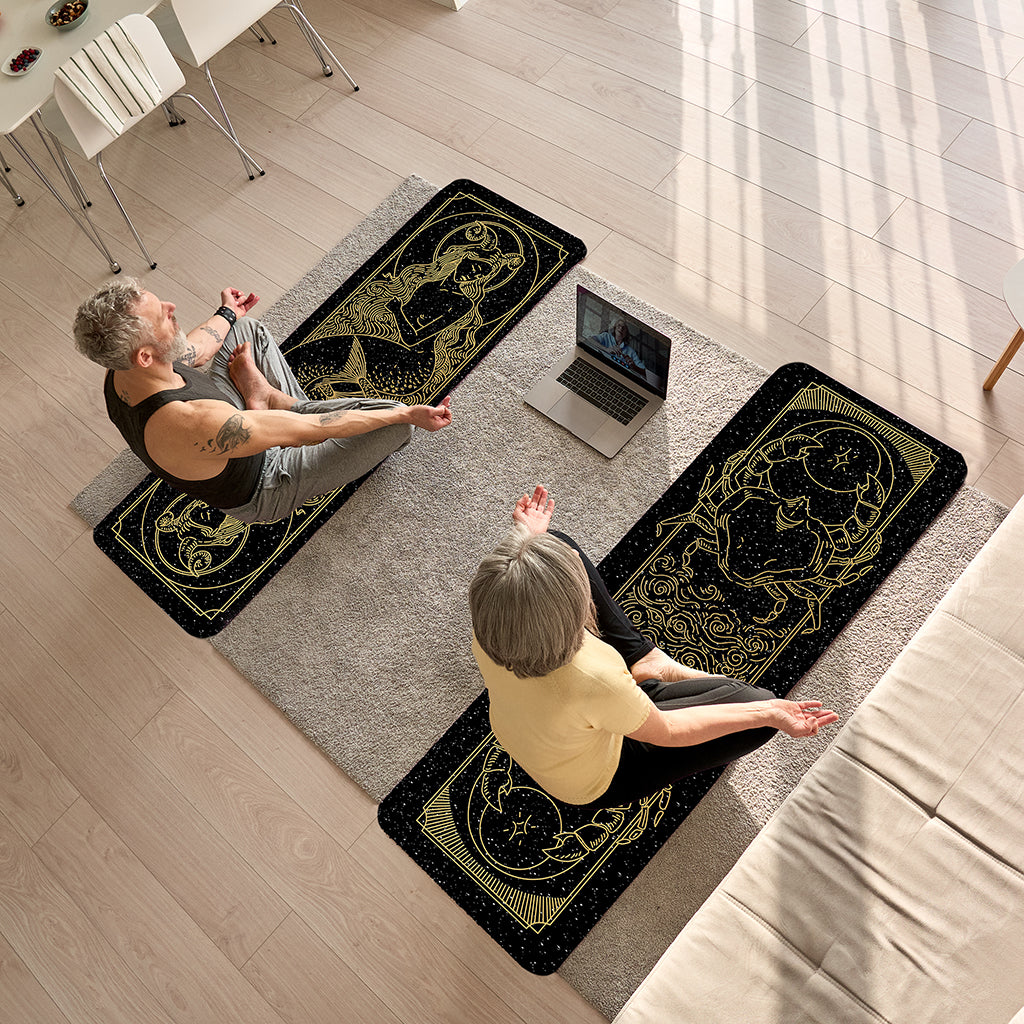
A yoga mat already rolled out.
A plant nearby.
A favorite blanket.
Morning sunlight coming through a window.
Nothing fancy.
Nothing Instagram-worthy.
Just a space that quietly reminds you that taking care of yourself matters.
The difference may seem small, but it changes everything.
Every retreat I host reinforces this lesson. People arrive believing they need more motivation. What they often discover is they simply needed an environment that supported the person they wanted to become.
The same thing can happen at home.
Your yoga space does not need to be perfect.
It simply needs to invite you in.
That is one reason I love artist-designed yoga mats so much. They become part of the environment. Instead of looking like another piece of fitness equipment, they become something personal. Something that feels less like a chore and more like an invitation.
And invitations are much easier to accept than obligations.
Start Before You Feel Ready
There is something I've noticed over the years.
The people who benefit most from yoga are often the people who believe they are least qualified to do it.
The stiff people.
The busy people.
The anxious people.

The Crows Have Eyes
The people who have convinced themselves they're too old, too out of shape, too overwhelmed, or too late.
The truth is that yoga meets you exactly where you are.
Not where you wish you were.
Not where you think you should be.
Where you are.
Today.
Right now.
You do not need to become flexible first.
You do not need to become calm first.
You do not need to become a different version of yourself first.
You simply need to begin.
Maybe that means five minutes.
Maybe it means one pose.
Maybe it means sitting quietly and breathing.
That is enough.
More than enough.
Your Permission Slip
If you've been waiting until you're more flexible, calmer, stronger, thinner, younger, or somehow more deserving of yoga, consider this your permission slip.
You are already qualified.
You always were.
Start where you are.
Take a breath.
Roll out a mat.
See what happens next.
A mat will not do the practice for you.
But the right mat can make the practice feel easier to return to.
If this article resonates with you, you might also enjoy reading Beginning Yoga in Your 50s: It's Never Too Late and How to Stay Consistent with Yoga: Your Environment Matters More Than Discipline.
Ready to Begin?
Find the mat that makes you want to begin again.
Explore our collection of artist-designed yoga mats and choose one that feels like it belongs in your home, your practice, and your life.